How much batter does that tin take?
Scaling a recipe up is easy to get wrong in the direction that hurts: one tin short, oven already hot, and a client expecting three tiers.
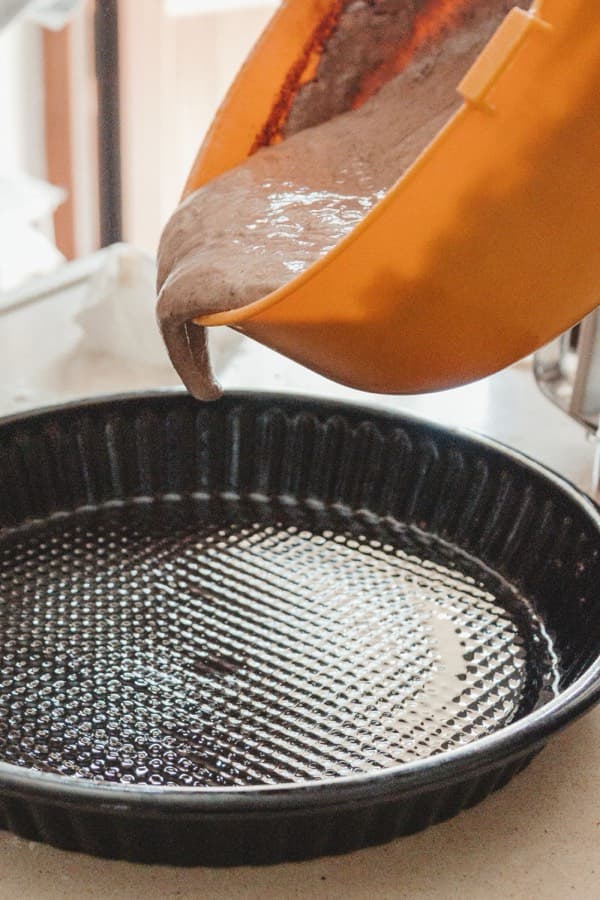
Work in batches, not cups
Every recipe scales differently, so a chart that tells you 'six cups of batter' is only useful if your recipe happens to yield in cups you have measured. The number that transfers between kitchens is volume: how many cubic centimetres of finished cake a tin holds.
Once you know the volume of your own recipe — bake it once in a tin you have measured, or simply note that a typical single-tier home recipe yields around 3,000 cm³ — every tin size becomes a straightforward fraction or multiple of it.
That is what the third column below gives you: not grams of somebody else's batter, but how many batches of a 3,000 cm³ recipe a given tin takes.
Volume and weight by tin size
For a round tin filled to a baked height of four inches. The weight columns are the weight of the baked sponge — see the caveat below.
| Tin | Volume | Batches | Light sponge (0.5) | Chocolate (0.85) | Fruit (1.1) |
|---|---|---|---|---|---|
| 6″ × 4″ | 1,853 cm³ | 0.62 | 927 g | 1,575 g | 2,039 g |
| 8″ × 4″ | 3,295 cm³ | 1.10 | 1,647 g | 2,801 g | 3,624 g |
| 10″ × 4″ | 5,148 cm³ | 1.72 | 2,574 g | 4,376 g | 5,663 g |
| 12″ × 4″ | 7,413 cm³ | 2.47 | 3,707 g | 6,301 g | 8,155 g |
| 14″ × 4″ | 10,090 cm³ | 3.36 | 5,045 g | 8,577 g | 11,099 g |
Why flavour changes everything
A light vanilla sponge is about half air by the time it comes out of the oven — 0.5 g/cm³. A chocolate mud cake is 0.85, and a fruit cake 1.1, denser than water. The same tin, filled to the same line, produces cakes that differ in weight by more than double across that range.
This is why scaling by weight between flavours goes wrong. If you know your vanilla recipe fills an 8-inch tin and you scale the same weight of mud batter into it, you will overfill it — and mud cake, being denser and slower to bake, is exactly the batter you least want spilling over.
Scale by volume between flavours, and by weight only within a flavour.
Doubling the diameter does not double the batter
Volume goes with the square of the radius, so a 12-inch tin holds four times what a 6-inch one does, not twice. That single fact accounts for most under-baking disasters: someone steps up two tin sizes, makes one and a half times the batter, and comes up badly short.
From the table: 6 inches takes 0.62 of a batch, 12 inches takes 2.47. Four times, exactly as the geometry says.
- Going up one standard size (6→8, 8→10) needs roughly 1.7× the batter.
- Going up two sizes (6→10, 8→12) needs roughly 2.8×.
- Adding two inches of height to the same diameter needs 1.5× — height scales linearly, unlike width.
Try it without signing up
Pick a cake, change its colours and finish, and watch the price move.
Loads a 3D viewport · works best on desktop
Frequently asked
How much batter do I need for an 8 inch cake tin?
An 8-inch round baked to four inches tall holds about 3,295 cm³ — roughly 1.1 batches of a typical 3,000 cm³ home recipe. In baked weight that is about 1.65 kg of light sponge, or 2.8 kg if it is a chocolate mud.
How do I convert a recipe from one tin size to another?
Scale by volume, not diameter. Divide the new tin's volume by the old one and multiply the recipe by that. Going from an 8-inch to a 10-inch is a factor of about 1.56, not 1.25 as the diameters might suggest.
Is this raw batter weight or baked weight?
Baked. The model works in finished cake, because that is what gets weighed, priced and served. Raw batter is roughly a tenth heavier before the water bakes off.
How full should I fill a cake tin?
Around two-thirds, for a sponge that rises. The volumes here describe the finished cake, so a tin holding 3,295 cm³ of baked cake needs to be deeper than that or the batter goes over the side.
Keep reading
How Much Does a Cake Weigh?
Finished cake weights by tier size, built up from sponge, filling and covering, plus the densities behind them and why the board is excluded.
How Much Buttercream to Cover a Cake
Buttercream quantities by tier size, with coating and filling worked out separately — so you can weigh out one batch instead of guessing and making two.
Cake Costing Guide for Bakers
How to work out ingredient, labour and overhead costs per cake, so your prices are built on real numbers instead of guesswork.
Start designing and pricing your cakes
Sign in with Google or email and start designing — no waitlist, nothing to install.