How much does a cake weigh?
You need this number more often than you would think: to quote by the kilo, to size a box, to decide whether the stack needs dowels, and to know what you are carrying to the car.
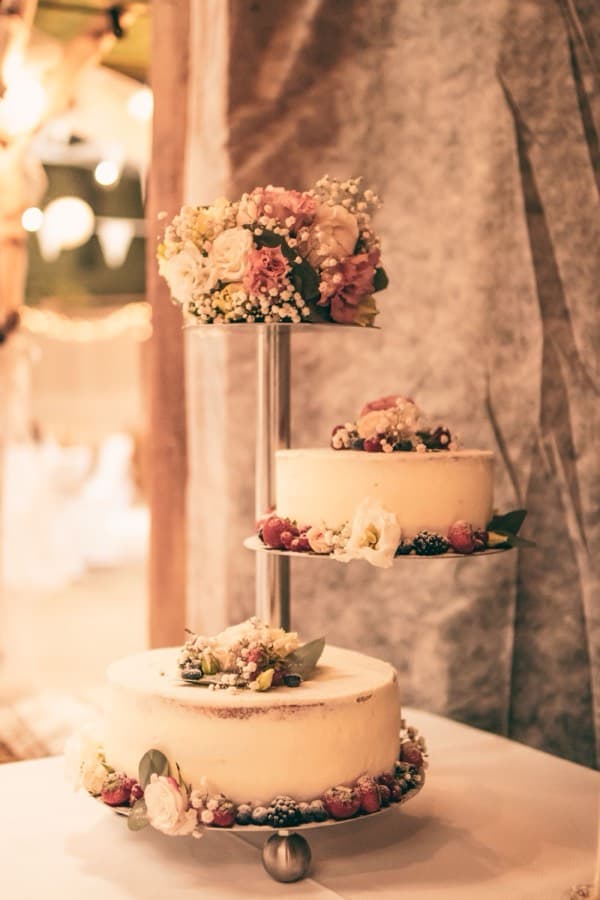
A cake is three weights, not one
Sponge, filling and covering each behave differently, and adding them up in that order is the only way to get an answer you can defend. Sponge dominates — it is most of the volume — but it is also the lightest thing per cubic centimetre, because a good sponge is mostly air.
The covering is the opposite: a thin skin, but dense. Fondant at 1.5 g/cm³ is the heaviest material on most cakes, which is why a fondant-covered tier can weigh noticeably more than a buttercream one of exactly the same size.
Work it out this way and the number stops being a guess. It also stops being a single number: 'an 8-inch cake' can reasonably weigh anywhere from 2.5 to 4 kg depending on height, filling and finish.
Finished weight by tier size
A light sponge, torted into three layers with two fillings, finished in buttercream. Board not included — see below.
| Tier | Sponge | Coating + filling | Total |
|---|---|---|---|
| 6″ × 4″ | 927 g | 644 g | 1.57 kg |
| 6″ × 6″ | 1,390 g | 783 g | 2.17 kg |
| 8″ × 4″ | 1,647 g | 1,022 g | 2.67 kg |
| 8″ × 6″ | 2,471 g | 1,206 g | 3.68 kg |
| 10″ × 4″ | 2,574 g | 1,481 g | 4.05 kg |
| 10″ × 6″ | 3,861 g | 1,712 g | 5.57 kg |
| 12″ × 4″ | 3,707 g | 2,021 g | 5.73 kg |
| 12″ × 6″ | 5,560 g | 2,298 g | 7.86 kg |
| 14″ × 4″ | 5,045 g | 2,643 g | 7.69 kg |
| 14″ × 6″ | 7,568 g | 2,967 g | 10.53 kg |
The densities behind the numbers
These are the figures the calculation uses. They are worth publishing because the reasoning matters more than the numbers — if your sponge is denser than this, you can adjust.
| Material | Density | Why |
|---|---|---|
| Light sponge | 0.5 | Mostly air once baked — the default when the flavour gives no clue |
| Chocolate / mud | 0.85 | Denser crumb, less aeration |
| Fruit cake | 1.1 | Barely aerated and full of fruit; the heaviest cake by a distance |
| Buttercream | 0.95 | Whipped, so lighter than the butter it is made from |
| Fondant | 1.5 | Dense sugar paste — the heaviest thing on most cakes |
| Ganache | 1.1 | Chocolate and cream, just heavier than water |
| Drum board | 0.45 | An effective density: a drum is mostly air between two card faces |
Why the board is excluded
If you sell by weight, the board must not be in the number. A 12-inch drum is around 395 g — on a small cake that is a meaningful fraction of what the customer would be paying for, and charging for it is indefensible if anyone ever asks.
It matters for the other uses too. For a delivery box you want the weight including boards; for a per-kilo price you want it excluded; for a dowelling decision you want the weight of everything sitting above the tier you are checking. Same cake, three different numbers, and mixing them up is how a quote ends up wrong.
How accurate is this?
The geometry is sound and the densities are reasonable, but your sponge is not our sponge. If you bake a heavier crumb than the 0.5 g/cm³ assumed here, everything scales up — and the fix is to weigh one tier you have already made, compare it to the table, and carry that ratio forward.
Treat the numbers as a well-founded starting point that you calibrate once against your own baking, rather than as a measurement of your cake.
Try it without signing up
Pick a cake, change its colours and finish, and watch the price move.
Loads a 3D viewport · works best on desktop
Frequently asked
How much does an 8 inch cake weigh?
About 2.7 kg for a 4-inch-tall buttercream-finished round: roughly 1.65 kg of sponge plus a kilo of filling and covering. A 6-inch-tall tier of the same diameter comes to about 3.7 kg.
How much does a three tier wedding cake weigh?
A 10/8/6 stack of 4-inch tiers is around 8.3 kg of cake. Add boards, dowels and a stand and you are lifting well over 9 kg — all of it bearing down on the bottom tier.
Does fondant make a cake much heavier?
Yes, more than most people expect. Fondant is 1.5 g/cm³ against buttercream's 0.95, so a fondant covering weighs roughly one and a half times a buttercream one of the same thickness — and fondant coverings are usually applied thicker.
Should the cake board be included in the weight?
Not if you are pricing by the kilo — the customer is not buying the board. Do include it when you are working out what fits in a box or what the bottom tier has to carry.
Keep reading
Cake Serving Chart & Size Guide
Cake serving charts for round, square and sheet cakes, with party and wedding slice sizes side by side — plus how many each tier size actually feeds.
How to Stack a Tiered Cake
Dowelling, boards and offsets for tiered cakes — including an actual number for how far a tier can sit off-centre before it needs internal support.
Cake Batter Calculator by Tin Size
How much batter each tin size takes, as batches of your own recipe rather than someone else's cups — plus how flavour density changes the answer.
Start designing and pricing your cakes
Sign in with Google or email and start designing — no waitlist, nothing to install.