How to stack a tiered cake without it leaning
Everyone tells you to dowel a tiered cake. Almost nobody tells you when, or how far off-centre is too far. Here is the arithmetic behind both.
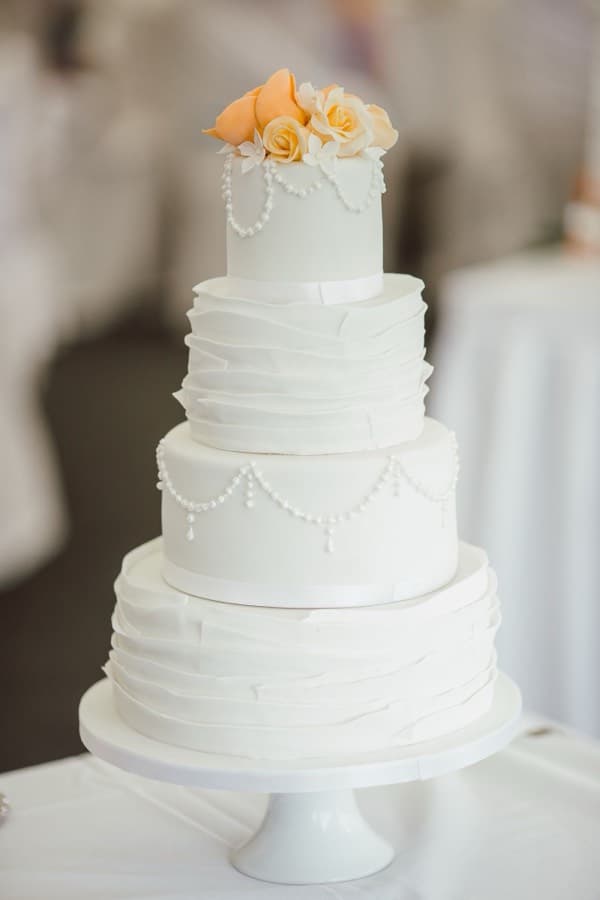
What actually makes a stack fall over
Not weight. A four-inch tier of sponge is strong enough in compression to hold several tiers — what fails is the edge. The combined centre of mass of everything above an interface drifts sideways, out towards the rim of the tier below, and past a point the supporting cake crushes on one side and the whole thing tips.
So the useful question is not 'how heavy is it' but 'how far off-centre is the load'. That is measurable: take the centre of mass of everything above a given joint, and compare its offset to the radius of the surface holding it up.
The designer runs exactly this check at every interface. The thresholds below are the ones it uses.
How far off-centre is too far
Expressed as a fraction of the supporting tier's top radius: within half of it, the stack is comfortably stable. Between half and 85%, it will stand but needs internal dowelling to stay standing. Past 85%, it is going over.
In millimetres, for common tier sizes:
| Supporting tier | Top radius | Fine as-is | Dowel it | Won't stand |
|---|---|---|---|---|
| 6″ | 76 mm | up to 38 mm | 38–65 mm | over 65 mm |
| 8″ | 102 mm | up to 51 mm | 51–86 mm | over 86 mm |
| 10″ | 127 mm | up to 64 mm | 64–108 mm | over 108 mm |
| 12″ | 152 mm | up to 76 mm | 76–130 mm | over 130 mm |
| 14″ | 178 mm | up to 89 mm | 89–151 mm | over 151 mm |
A centred stack is always fine — so why dowel at all?
Because the offset test is only half the story. Even perfectly centred, the tier below is soft and the tier above is heavy, and over several hours the lower tier compresses, bulges at the sides and the upper tier sinks into it. Dowels take that load off the cake entirely.
The rough guide: dowel any tier that has another tier on top of it. On a two-tier cake you can occasionally get away without, if the top tier is small and the cake is being cut within the hour. On anything three tiers or more, or anything travelling, or anything standing through a long reception, dowel it.
The offset table matters for the other case — designs where tiers are deliberately staggered. That is where people get caught out, because a stagger that looks modest can put the load much further out than it appears.
Support the bottom, not just the joints
- The bottom tier carries everything. A 10/8/6 stack of four-inch tiers is around 8.3 kg of cake, all bearing on that base — which is why a thin board under the bottom tier is a bad idea above two tiers.
- Use a drum, not card, at the base. A drum is stiff enough not to flex when you lift from the edges; card is not, and a flexing board cracks the tier above it.
- Match board diameter to tier diameter for internal boards, so no board edge shows and the tier above sits fully supported.
- For transport, cold cake and a flat car floor beat any amount of dowelling. Most stacking disasters happen in a car, not on a table.
The honest limits of the model
The check assumes each tier's mass acts on its own axis, and treats supporting faces as round at their top radius. Both are deliberately conservative: a square tier genuinely supports more than the circle drawn inside it, so if the numbers say you are fine, you have margin in hand.
What it does not model is your cake's structure — a very soft mousse-filled tier will misbehave well inside these limits, and a firm fruit cake will tolerate more. Treat the thresholds as a floor to design above, not a licence to push right up to the line.
Try it without signing up
Pick a cake, change its colours and finish, and watch the price move.
Loads a 3D viewport · works best on desktop
Frequently asked
Do I need dowels for a two tier cake?
Usually yes, and always if it is travelling or standing for more than an hour or two. The top tier will slowly sink into the bottom one otherwise, bulging the sides. A small top tier on a cake being cut immediately is the one case you can reasonably skip it.
How far can a tier sit off-centre?
Up to about half the radius of the tier supporting it and you are fine — around 51mm on an 8-inch tier. Between half and 85% of the radius it needs dowelling. Beyond 85% it will not stand, whatever you do.
How many dowels per tier?
Four in a circle about 20mm inside the footprint of the tier above is the usual minimum, plus one in the centre once you are above two tiers. More matters less than getting them all cut to exactly the same length.
Why is my tiered cake leaning?
Nearly always dowels cut to slightly different lengths, so the board above rests on the longest one and tilts. The other common cause is a board that flexes — thin card under a heavy bottom tier bows in the middle and everything above follows it.
Keep reading
How Much Does a Cake Weigh?
Finished cake weights by tier size, built up from sponge, filling and covering, plus the densities behind them and why the board is excluded.
Cake Serving Chart & Size Guide
Cake serving charts for round, square and sheet cakes, with party and wedding slice sizes side by side — plus how many each tier size actually feeds.
3D Cake Design Software
Design cakes in 3D in your browser. Build tiers, add decorations, and show clients a realistic preview before you bake — with instant pricing built in.
Start designing and pricing your cakes
Sign in with Google or email and start designing — no waitlist, nothing to install.